Holdout Tests vs. A/B Tests: When to Measure True Incremental Lift
Learn which testing methodology accurately measures the ROI of your marketing spend.
Authored by Lalit Jain · lalit.7.jain@gmail.com · LinkedIn
For most marketers, the standard A/B test is the default for campaign optimization. But when it comes to proving the true value of an *entire marketing channel*—such as Paid Social or Display—the A/B test falls short. This is where the **Holdout Test** becomes essential.
While an A/B test measures the best creative, the Holdout Test measures **incrementality**: "Did this marketing dollar create a conversion that wouldn't have happened otherwise?" Understanding this difference is key to budgeting and scaling accurately.
The Standard A/B Test: Measuring Variants
A standard A/B test compares two groups (A and B) who are both *exposed* to the campaign or website experience. It answers questions like:
- Does 'Headline A' convert better than 'Headline B'?
- Does the new landing page design increase sign-ups?
**The limitation:** An A/B test assumes the audience is already interested or exposed to the channel. It doesn't account for users who might have converted organically or through another channel, leading to inflated ROI claims.
The Holdout Test: Measuring True Incremental Lift
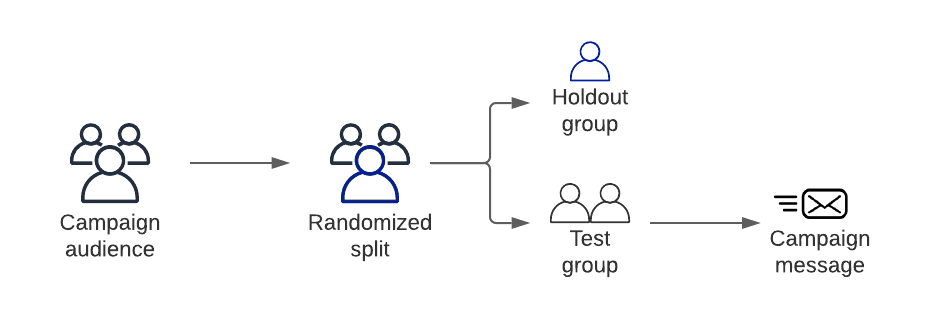
The Holdout Test is designed to prove that a specific marketing action *causes* a conversion. It works by creating a **Holdout Group**—a scientifically selected portion of your target audience that is deliberately prevented from seeing the paid campaign.
The test then compares the total conversions (organic + paid) of the **Exposed Group** against the total conversions (organic only) of the **Holdout Group**. The statistically significant difference between these two rates is the **true incremental lift** driven by the channel.
When to Choose a Holdout Test
Use a Holdout Test when you need to answer fundamental business questions:
- **Budget Allocation:** Should we spend $1M on this channel next quarter?
- **Channel Efficiency:** Is our Paid Search driving *new* customers, or just recapturing users who searched for us anyway?
- **Stopping Decisions:** What would happen to sales if we turned this specific channel off?
Because the statistical noise is much higher in a Holdout Test (you are measuring a tiny difference between a baseline CVR and a slightly higher CVR), the **required audience size** is often massive. This makes proper planning essential.
Plan Your Incremental Test Accurately
Don't launch a Holdout Test without validating your audience size. Switch to the **Holdout Test mode** in our free **Statistical Significance Calculator** to instantly determine the exact audience size required to prove incrementality with confidence.
In summary, use A/B tests for optimization and Holdout Tests for validation. Knowing when and how to deploy each is the key difference between a good marketer and a great one.
Recent Updates & Change Log
[Sept, 2025]
- Added ability to calculate **Achievable Lift (MDE)** in both Absolute and Relative terms for Holdout Tests.
- Implemented **Holdout Test Mode** to determine required audience size for incremental lift.
- Added **Dynamic Split Slider** for A/B test budget distribution.
- Implemented a clear **Calculation Breakdown** and actionable **Recommendations**.
This tool is actively maintained and improved.